How would you know if your synthetic users are right?
Tookii · June 21, 2026 · 6 min read

Someone shows you a synthetic user that sounds exactly like your customer. One question decides whether it's worth anything: how would you know if it's right?
Not does it sound right. It will. Sounding right is the one thing these systems are guaranteed to do. Right is a different claim, and it's the one you're actually betting the roadmap on.
Here's the trap most teams fall into. They can't answer the question, so they reach for a number someone handed them. Vendors are happy to supply one: you'll see persona accuracy quoted as a correlation as high as 95%. It sounds like proof. It isn't. Not because it's faked, but because a single headline number is the easiest thing to put on a slide and the least informative thing about whether you can trust these personas for your decision. Right isn't an adjective you attach with one statistic. It's a measurement, and it takes three checks.
The short answer
"Right" isn't a property a persona has. It's a measurement you take, and it takes three checks. First, compare the persona's answers against real humans on something you already know the answer to. Second, compare distributions rather than averages, because a cohort that matches the mean while collapsing the spread has hidden exactly the people who break your assumptions. Third, name the boundary: validity is earned per decision, so a persona verified for pricing questions hasn't been verified for onboarding. A single headline accuracy figure from a vendor fails all three, because it averages across tasks that behave completely differently and was measured on someone else's decision, not yours.
| Check | The question it answers | What passing looks like |
|---|---|---|
| Against real humans | Does this persona track people who actually exist? | Its answers match known outcomes from your real users |
| Distribution, not average | Does it reproduce the spread, or just the center? | Disagreement and outliers survive, not only the median |
| Name the boundary | Verified for which decision? | A stated scope, and a re-check when you leave it |
1. Check it against real humans
There's no internal test for "right." A synthetic user can't certify itself; the word only means something relative to real people doing the real task. The research is blunt about it: you validate by replicating a slice of the work with actual humans and comparing the outputs directly. Where you can't, you're not measuring validity. You're asserting it.
The unglamorous part is that you need real signal in the loop: a handful of interviews, support tickets, NPS verbatims, a small panel. Something human to check against. Even the practitioners most bullish on synthetic users agree the only thing that validates one is real human research. No human anywhere in the loop isn't confidence. It's vibes with a progress bar.
2. Compare the distribution, not the average
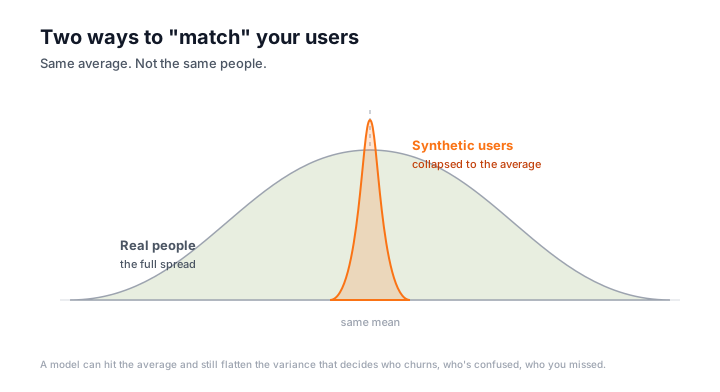
This is where that 95% hides its sins. A model can nail the average and flatten everything around it. And the spread is usually the point. Real people disagree; they cluster, they throw outliers, they contain the strange 8% who churn for reasons the median never sees. LLMs are notoriously thin here: their responses show far lower variance than real interpersonal variance, and they routinely fail to match the critical moments of a human distribution: variance, quantiles, skew. Serious validation compares the whole shape against humans, not just the center.
So a correlation can read 0.95 and still miss every person who matters. Matching the mean is the trick that looks like accuracy. Matching the distribution is accuracy.
3. Name the boundary
A validated synthetic user is valid for a decision and a moment. Not in general, and not forever. Validity doesn't travel across tasks: the same model can sit inside the human range on five economic games and break on the sixth. And it doesn't travel across time: models are trained on the past, so previous alignment doesn't guarantee current applicability: they miss shifts in attitude, language, and what people have started to care about.
So the honest output of validation isn't "these personas are accurate." It's "these personas track real people on this question, right now. And here's where they stop." Confidence you can't draw a boundary around isn't confidence. It's a guess that hasn't failed yet.
What this actually costs
Three checks is more work than a dashboard wants you to believe, and none of them are exotic: they're just the difference between a tool you trust and a tool that flatters you. A number on a slide is not the same as confidence. Confidence is knowing which of the three you ran, and what each one told you.
That's the bar. It's higher than "sounds like my user," and it's the only one that protects the decision underneath.
Three questions, not one
The next time something sounds exactly like your customer, you've got three questions instead of one. Did you check it against a real person? On the spread, not the average? And for this decision, right now?
A synthetic user is never right just because it's convincing. Convincing is free. Right is what's left after you've checked. Skip that, and the most lifelike persona on your screen is just a confident guess you've chosen to believe.
FAQ
How accurate are synthetic users? There's no honest single number, and no independent benchmark exists for any commercial tool in this category. Accuracy varies sharply by task: the same grounded agents that reproduce survey responses closely can drop to near-zero correlation on strategic games. Treat every vendor figure as unverified until you have tested it on your own decisions.
What does it mean to validate a persona? To compare its output against known human outcomes for a specific decision, on the distribution rather than the average, and to state the scope within which the result holds. Validation is a measurement with a boundary, not a certificate that travels with the persona.
How many real users do I need to validate against? Fewer than you would need for discovery, because you're checking a prediction rather than exploring an unknown. Ten decisions where you already know the human answer will separate a useful tool from a convincing one.
Why is a 95% accuracy claim not proof? Because it averages across tasks that behave differently, and it was measured on someone else's decision. A number that high usually means an easy benchmark rather than a reliable instrument, and it tells you nothing about the question you're about to ask.
Next
Deciding which tool to run that check on? We ranked the category in the best synthetic user testing tools in 2026. And what a persona was built from settles most of the answer before you check anything.