Synthetic users, done right
Tookii · June 26, 2026 · 8 min read

Synthetic users (AI personas that stand in for your real customers) are the fastest way to pressure-test a decision before you put anything in front of a real person.
They're also easy to get wrong. Most are too agreeable, too generic, too confident to trust: they tell you what you hoped to hear and call it research. The entire difference between a synthetic user that sharpens your thinking and one that just flatters it comes down to how it's built.
This is what built-right looks like. And it's what we made Tookii to do.
The short answer
Every way synthetic users fail is a choice someone made, which means every one of them can be reversed. A trustworthy synthetic user is grounded in real signal about your market rather than conjured from a demographic label. It reflects a genuine range of people instead of collapsing into one agreeable average. It behaves rather than merely answering, using your live page the way a person would. Its inherited bias is controlled rather than passed through. Its findings trace back to something you can watch happen. And its accuracy is measured against a bar it can fail, not claimed in a tagline. Tookii is built to clear all six, and reachable from the tools you already work in.
| The failure | The reversal |
|---|---|
| Conjured from a demographic label | Grounded in your site, market and your own data |
| Collapses to one agreeable average | Built as a cohort of genuinely different people |
| Answers questions but never acts | Uses your live page or prototype like a person |
| Inherits the model's bias | Built to counter it, grounded in behavioral research |
| Findings you have to take on faith | Traceable to something you can watch happen |
| Accuracy claimed in a tagline | Measured per decision; unproven changes don't ship |
What makes a synthetic user worth trusting
A synthetic user is only as good as what goes into it. To actually move a decision, it has to be grounded in real signal about your market, not conjured from a demographic label. It has to reflect a real range of people, not collapse into one agreeable average. Its built-in bias has to be controlled, its findings have to trace back to something you can see, and (the part almost everyone skips) its accuracy has to be measured, not just claimed.
That's the bar. Most tools clear none of it. Here's how Tookii meets each one.
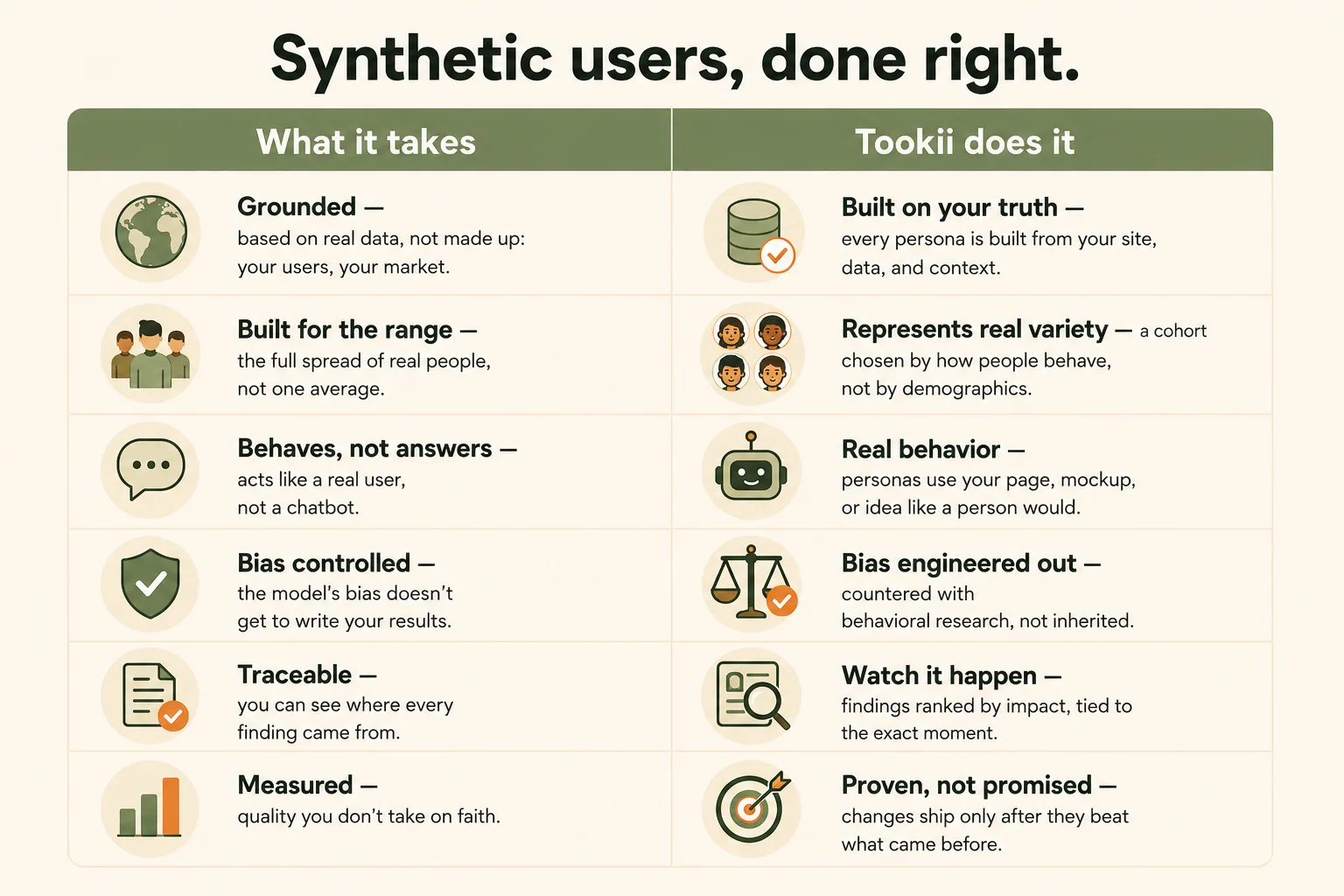
Grounded, not guessed
A Tookii persona doesn't start from "a 34-year-old PM." It starts from your real signal. Point it at a URL and it reads your site, your positioning, and your competitors; hand it your own data (interviews, support tickets, past research) and it builds from that, every trait traceable to the source it came from. The persona isn't a guess pinned to a demographic label. It's an argument from evidence about who your users actually are.
Built for the range, not the average
The quiet killer is the bland median: one agreeable "average user" who doesn't actually exist. Tookii builds the opposite: a cohort of genuinely different people, chosen by how they behave rather than which demographic box they tick. The skeptic, the impatient one, the person who pushes back on your premise: they're exactly who you want in the room, because they find what's wrong before your customers do.
They behave, not just answer
Sounding like a user was never the same as behaving like one. So Tookii's personas don't fill out a survey. They actually use what you give them. Point them at a live page, a rough mockup, two directions you're choosing between, or an idea you haven't built yet, and they move through it the way a real person would: clicking, hesitating, getting confused, giving up. You can test a direction before you commit to building it. Then interrogate the personas about it, one or a whole panel, following up question by question while they remember what they said.
Built to counter bias, not inherit it
Here's the hard part most tools ignore. The moment you use a language model to stand in for a person, you inherit the model's baggage: its pull toward agreement, its blind spots, its habit of smoothing everyone toward the same safe middle. Left alone, that baggage quietly writes your results. This is the deep problem with synthetic users, and it's bigger than any single feature.
Tookii is built to counter it. The engine is shaped by behavioral-science research on how people actually make decisions, and on exactly where language models drift away from them, so what comes back reflects the person, not the model's defaults. The how is our own work. What matters to you is that the bias isn't hiding inside the answer.
Findings you can act on
A result you can't trace is a result you can't use. Tookii pulls together what the personas ran into, ranks it by how much it actually matters, and ties every finding to the exact moment it happened. So you can watch it. You don't read that the checkout confused people. You watch it confuse them.
And it's measured
Most tools ask you to take their quality on faith. We don't. Every improvement to how Tookii builds personas has to clear a measured bar: it has to demonstrably beat what came before, or it doesn't ship. You're not getting our latest guess. You're getting the version that proved it was better.
Inside the tools you already work in
Your work already lives in flows: discovery, research, validation, prioritization, design, build. Tookii plugs into them. Through its MCP server, you can reach your synthetic users from inside the tools you already use (Claude, Cursor, your own pipeline) without breaking stride. Mid-decision, you can sanity-check a direction, weigh two options, or pressure-test a flow and get an answer in the same breath instead of days later. It's a way to de-risk decisions, explore directions, and cut the noise. So by the time you sit down with real users, you're asking sharper questions about a tighter set of options.
What it isn't
Tookii isn't a replacement for talking to real people, and we'd never sell it as one. Real research is still how you learn the deepest things: what someone will truly pay for, what they actually feel, who they trust. I've spent enough hours in real sessions to respect both halves of that. The deepest insight comes from real people. So does a lot of dead time: the scheduling, the no-shows, the call with someone who took it while driving. Real research is irreplaceable. A good chunk of the work around it has nothing to do with learning. What Tookii gives you is speed and focus: move faster between those conversations, kill weak options early, and walk into real research already knowing which questions are worth asking. Not a crystal ball that promises the future. A faster, sharper way to decide what's worth putting in front of real people.
So
Synthetic users were never the problem. The shortcut was. Tookii is the version that skips nothing: grounded, varied, bias-controlled, traceable, and measured. And it lives in the tools you already use.
That's what done right looks like. Now you know what to demand from anything that calls itself a synthetic user. Including us.
FAQ
What is Tookii? A synthetic user testing tool. It builds personas from your real market signal, your site, your uploaded data and your competitive context, then runs them through your live page or prototype in a real browser so you can see where people would hesitate or give up. It's reachable over MCP from the tools you already work in.
How is Tookii different from Synthetic Users? Synthetic Users simulates the interview, so you get transcripts and themes about what a person would say. Tookii runs personas through the product itself, so you get behavior. The longer comparison sits in the best synthetic user testing tools in 2026.
Is Tookii accurate? Accuracy is measured per decision against a committed benchmark, and prompt changes that score worse than the version they replace don't ship. The honest caveat applies to us as much as anyone: no independent third-party benchmark exists for any tool in this category. Run ten decisions you already know the human answer to, and score us before you trust us.
Does Tookii replace user research? No. It's a narrowing instrument. It kills the weak hypotheses overnight so the survivors earn a real person's time, and it can't do discovery, which is the thing user research exists for.
What does Tookii cost? Pricing is coming soon; Pro and Team plans ship with the general release. Testing is free to start today — no credit card.
Next
Hold us to it: we put ourselves next to the alternatives in the best synthetic user testing tools in 2026. New to the category? Start with what synthetic users are.