Four ways synthetic users lie to you
Tookii · June 15, 2026 · 8 min read

A synthetic user will never tell you your idea is bad. Not because it's being polite. Because it can't see the person who would.
Call it a lie because that's how it functions: it tells you something false while sounding completely true. Not malice. A model has no motive. Mechanism. A language model is built to produce the most likely, most agreeable continuation of the text in front of it, and "likely and agreeable" is not the same as "real and varied." Point a tool like that at the question how would my users react? and it hands back a clean, confident answer that misses the actual human in four specific, well-documented ways. None of them are bad luck. All of them are predictable.
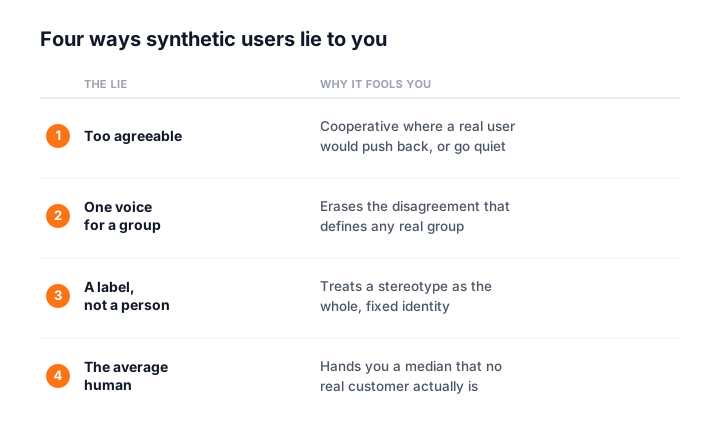
The short answer
Naive synthetic users fail in four documented ways, and all four share one root: the model optimizes for the likely and the agreeable, while real people are varied and difficult. It's too cooperative where a real user would push back. It speaks for a whole group in a single voice, erasing the disagreement inside any real one. It treats a demographic label as if it were a person. And it hands you an average that no actual customer is. None of these are bad luck or model defects to wait out. Each has a known cause and a known fix: ground the personas in real human data, build the variance and friction back in, then validate against real people before trusting the output.
| The lie | What it looks like | Root cause | The check |
|---|---|---|---|
| Too agreeable to be real | Cheerfully confirms whatever you hoped | Trained toward likely and agreeable continuations | Does it ever push back, stall, or refuse? |
| One voice for a whole group | A single confident opinion per segment | Group identity collapsed into one persona | Does the cohort disagree with itself? |
| A label, not a person | Stereotype stands in for the whole identity | Demographic tag treated as a full description | Is it built from real behavior or a job title? |
| The average is no one | A bland median with the tails sanded off | Repeated sampling collapses toward the mean | Do you see the spread, or just the center? |
1. It's too agreeable to be real
This is the one you can feel. Real users are difficult on purpose: they withhold, hesitate, push back, lose patience, go terse. Default synthetic users do the opposite: they're "overly cooperative, perfectly consistent, and highly forthcoming," handing over whatever you ask for in tidy full sentences. Researchers call the distance between the two the behavioral gap, and it isn't academic. A product that scores beautifully against the agreeable simulator can fall apart the second a frustrated, real human shows up.
Here's how slippery it gets. In one agent evaluation, swapping nothing but the model playing the user moved the measured success rate by nearly nine points, from 67% to 76% on the very same tasks. Same agent, same questions; change the imaginary user and you change the verdict. If the user is fiction, so is the score.
The fix: build the friction back in (impatience, skepticism, brevity) and ground it in how real users behave, not how you'd like them to.
2. It speaks for a whole group in one voice
Ask a synthetic user to represent "your enterprise buyers" or "new parents," and it will. As a single, smooth, averaged voice. The internal disagreement that defines any real group gets quietly erased. This isn't a tuning problem; it's structural. Models are trained to produce the most likely text, and the most likely text sits at the center of the distribution, so the edges disappear.
The measurement is stark. Across four LLMs tested against 3,200 real people on sixteen demographic identities, the models ran flatter than humans on nearly every measure of diversity: GPT-4 covering just three of five answer options across a hundred tries where real people used all five. And when a group is invoked, the model often answers from outside it. Asked for the perspective of a person with impaired vision, one model offered: "While I may not be able to visually observe the nuances... I believe..." A confident answer from someone who isn't there.
The fix: sample for variance and validate against the group's real spread. You can't prompt your way out of a training objective.
3. It mistakes a label for a person
"Act as a 34-year-old product manager." "Respond as a busy parent." The prompt treats a label as if it were a complete, fixed, uniform person. And the model obliges with a stereotype wearing a name tag. The research term is the identity-essentialization fallacy: it treats categories as "innate, static, homogeneous," when real identity is "fluid, contextual, and intersectional". A label is the first sentence of a person. The model reads it as the whole biography.
The fix: ground the persona in context and real data rather than a bare label, then validate against the actual population. (How to prompt that well is its own subject. We'll get to it.)
4. It hands you the average, and the average is no one
The deepest lie is the most reassuring: that the model behaves like "the average human," so it's a safe stand-in. It doesn't, and it isn't. On some tasks the model is superhuman: it beats people at detecting irony and at analogical reasoning; on others it underperforms them. It is not the average of anything. And where it does produce an aggregate, the variance runs far below the spread between real people, and tilts hard toward Western, educated, wealthy responses: one narrow slice of humanity dressed up as the default.
So even at its best, the synthetic user gives you a median. But a median is a statistical artifact, not a customer. Nobody is the average. The people who churn, who get confused, who love it for a reason you never designed: they live in the variance the model throws away.
The fix: model the distribution, not one median, and check its spread against real humans.
None of this is fatal, if you do the work
Notice the four lies share one root. The model optimizes for the likely and the agreeable; real people are varied and difficult. Every lie is a version of that one mismatch. And so is every fix. Ground the personas in real human data instead of a label. Build the variance and the friction back in. Then validate against actual people before you trust a word of it.
That isn't a counsel of despair, and the research is clear that it isn't. These are failures of the naive, off-the-shelf version: the one you spin up in a prompt and believe. They're answerable. Practitioners who've stress-tested synthetic users land in the same place: genuinely useful, but as something you build and verify, not something you buy and trust (NN/g).
The whole difference
A synthetic user hands you a clean, confident, agreeable story about a person who doesn't quite exist. That's not a malfunction. It's the default. The four lies are simply what the default costs you.
But none of them are laws of physics. Each one has a known cause, which means each one has a known fix: ground the personas in real behavior, build the variance and friction back in, and check them against real people. Do that, and a synthetic user stops being a flattering mirror and starts being an instrument.
That's the whole difference. Convincing was never the bar. Knowing where it would lie before you trusted it is.
FAQ
How do I test whether my synthetic users are lying? Check them against people. Compare the cohort's answers to outcomes you already know from real users, look at the spread rather than the average, and confirm the check still holds for the specific decision in front of you. How would you know if your synthetic users are right walks through all three.
Which of the four lies is the most expensive? The average that's no one. The other three distort a persona you're looking at; this one hides the people you never see. A cohort that matches the mean while collapsing the spread quietly removes the outliers whose behavior is usually what breaks the roadmap.
Do these four failures apply to every synthetic-user tool? They apply to the naive, off-the-shelf version: a persona spun up from a prompt and believed. Each has a known fix, so a tool that grounds personas in real data, models the spread, and measures itself against human outcomes escapes them by design rather than by luck.
Are these problems getting better as models improve? Partly, and not uniformly. Bigger models still show sensitivity to irrelevant persona details and still flatten group variance, so the fixes are architectural rather than something to wait out.
Next
Checking is its own discipline: how would you know if your synthetic users are right. For the definitions underneath all of this, see what are synthetic users.